
What is Web 3? Should Vancouver SMEs Invest in It in 2025?
Short answer: Web 3 is the next-generation internet concept built on blockchain, AI, and decentralized data ownership. But for the vast majority of small and medium-sized businesses in Vancouver, your website does not need any Web 3 changes right now.
If you run a local restaurant, retail shop, or professional service, putting budget into responsive design, page speed, SEO, and email deliverability gives a far better return than chasing Web 3. We have been building websites for 17 years, and we have watched plenty of business owners get talked into spending money on whatever the latest "industry trend" is. This article explains what Web 3 actually is, what it can do today, whether it affects you, and gives you a clear way to decide.
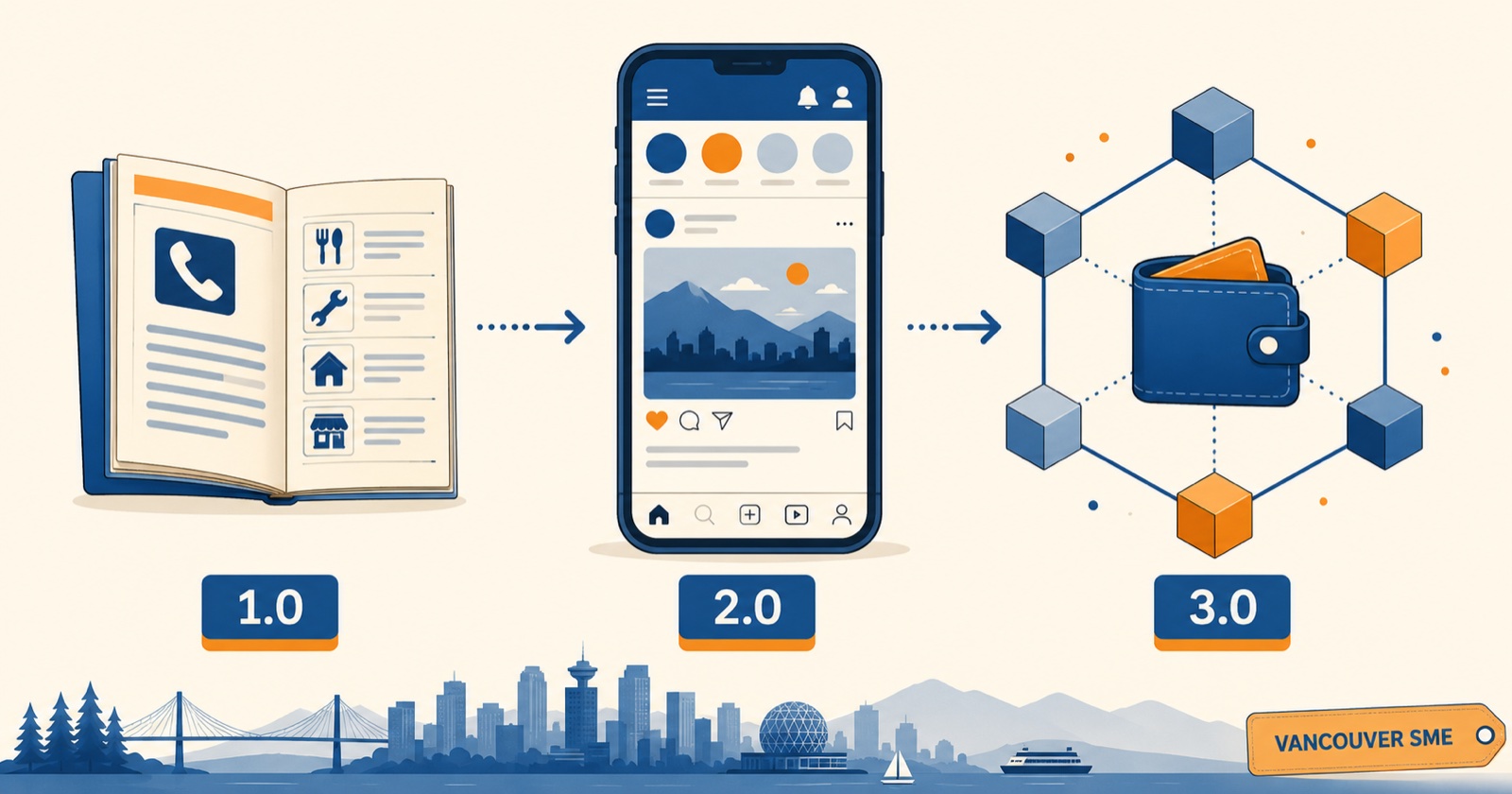
Web 1.0 → 2.0 → 3.0 at a glance
| Era | Years | User role | Representative products |
|---|---|---|---|
| Web 1.0 | 1995–2005 | Read only | Yahoo directories, brochure websites |
| Web 2.0 | 2005–today | Read, write, interact | YouTube, Facebook, Shopify, WordPress |
| Web 3.0 | Concept stage | Own your data and identity | Crypto wallets, NFTs, DAOs, decentralized IDs (DIDs) |
The key Web 3 shift is not user experience but control. Web 2 handed content control to users (anyone can post), but data control stayed with Meta, Google, and Amazon. Web 3 wants to hand data control back to users via crypto wallets, on-chain identity, and decentralized storage.
What can Web 3 actually do today? (with concrete examples)
Real, in-production use cases:
- Crypto checkout: Your customers can pay in Bitcoin or Ethereum. Install BitPay or Coinbase Commerce as a Shopify app — it works like the PayPal module. Mostly used by sellers in the crypto ecosystem itself (wallets, miners, chain-related services). A typical Vancouver restaurant or boutique has almost no demand for this.
- NFT membership cards and loyalty: Starbucks launched the Odyssey NFT loyalty program in 2022 (earn points, redeem NFT badges) — and shut it down in early 2024. Nike ran the .Swoosh digital sneaker platform. The takeaway: even Starbucks and Nike tried this and pulled back. The cost-to-return for an SME running its own NFT program does not work.
- Decentralized Identity (DID): Instead of "Sign in with Google" or "Sign in with WeChat", you sign in with a crypto wallet that only you hold the private key to — your data stays with you, not the platform. The W3C standard is still being finalized. You will not see this on mainstream business websites within the next 5 years.
Still mostly hype:
- DAOs (Decentralized Autonomous Organizations): a network organization where contributors vote on every decision via blockchain. The famous case is ConstitutionDAO in 2021 — 17,000 people crowdfunded $47 million in 72 hours to bid on an original printing of the US Constitution (and lost the auction). Great tech demo, near-zero commercial application.
- "Putting your business website on-chain": sounds futuristic, delivers no real value beyond a PR stunt, and is slower to load.
- The metaverse: peaked in 2022 and has deflated. Meta's Reality Labs division has accumulated more than $50 billion in losses, and Disney, Microsoft and others have shut down their metaverse teams.
Should your website be re-built for Web 3?
In 99% of cases: no.
Skip Web 3 entirely if your customer base is any of these:
- Local restaurants, retail, or professional services (legal, accounting, medical, education)
- Brick-and-mortar plus e-commerce extension
- B2B services (delivery, consulting, import/export)
Only consider a selective pilot if you fit one of these:
- Your customers already live in the crypto ecosystem: consider crypto wallet login or crypto checkout.
- You sell global digital goods (art, collectibles, digital assets): consider NFTs.
- Your brand positioning demands a "frontier" label: pilot Web 3 elements as PR, not as a main feature.
The decision rule is simple: in the last 12 months, how many customers have asked you "do you take crypto?" or "do you have an NFT membership?" If the answer fits on two hands, you do not need Web 3.
What matters far more than Web 3: get Web 2 right first
The Vancouver SME websites we audit usually still have unresolved Web 2 problems:
- Incomplete responsive design: poor mobile UX, and Google's mobile-first indexing drops your ranking.
- Slow page load: visitors leave before content renders. Bounce rate spikes.
- SEO basics missing: sitemap not submitted, Search Console errors, indexing gaps. Start with our Google Search Console guide.
- Email deliverability is broken: SPF, DKIM, DMARC not configured, mail goes to spam. See our DKIM setup guide.
- No analytics in place: Universal Analytics is gone. Without GA4, you are flying blind. See our GA4 migration guide.
Fixing any one of these returns more than chasing Web 3. On every 5U Website upgrade plan we put together for a client, Web 3 sits last on the list.
5U's position
We do not proactively recommend Web 3 changes unless:
- The client's business already lives in the crypto ecosystem (rare).
- The client explicitly wants a "frontier" brand signal and is willing to treat it as PR spend.
- There is real customer behavior data supporting the investment (not a guess).
If you are unsure whether your website needs any Web 3 elements, start with a Web 2 audit: responsive, speed, SEO, email authentication, analytics. Get those five things in shape first; Web 3 can wait. When you are ready to talk to 5U Website, read this short prep guide first so the quote we give you actually matches your needs.